Your Clients Are Already Being Targeted.
The Only Question Is Whether You've Prepared Them.
-
AI-powered deepfakes, romance scams, and financial fraud are devastating real clients right now.
-
Here is how to become the advisor who stands between them and the scammers — before the call comes.
It Started with a Normal Video Call
A finance employee at a Hong Kong multinational firm joined a video conference with his CFO and several colleagues. He recognized their faces. He recognized their voices. The meeting seemed completely routine. At the end of it, he transferred $25.6 million.
Every person on that call was a deepfake.
This was not a test. This was not a movie. This happened in 2024.
The fraud was discovered only when the employee checked with the real corporation afterward — long after the money was gone.
The criminals had used AI to synthesize the appearance and voice of real company executives and run a live video call from behind those fabricated identities.
The technology that made this possible is now widely available, inexpensive, and improving every month.
It is already being pointed at your clients — through phone calls that sound exactly like a grandchild in trouble, investment platforms that are indistinguishable from real brokerages, and romance profiles built from stolen photographs to exploit the loneliness of widowed retirees.
In 2024, Americans lost $16.6 billion to fraud — a 33% increase from the prior year. Behind every statistic is a retirement account, a home, a family.
You’re Already Seeing This
We recently surveyed more than 400 financial advisors about their direct, firsthand experiences with client fraud and scams. Their answers should concern every advisor in practice today.
86% of financial advisors have had at least one client targeted by attempted fraud or scams in the past five years.
58% have had clients who actually lost money to fraud or scams — not just targeted, but successfully victimized.
74% have suspected that cognitive impairment or possible dementia made a client more vulnerable to financial fraud.
37% feel "very confident" in their ability to identify potential financial fraud affecting their clients. Nearly two-thirds feel some degree of uncertainty about something that is already happening in their practices.
These are not projections. They are the reported experiences of advisors who look and practice exactly like you. The fraud is already reaching your clients.
The question is what can you do to help them before it happens AND when it does?

Get the presentation your clients need to see today!
Why This Threat Is Different
Traditional cybersecurity threats exploit software vulnerabilities. Hackers look for holes in code, expose weak passwords, or plant malware in downloads. Those threats are real and have not gone away.
But a new category of financial crime has emerged that does not exploit software at all. It exploits human beings — their emotions, their trust in authority figures, their instinct to protect the people they love, and the cognitive vulnerabilities that come with aging.
The scams that are destroying retirement savings right now include:
-
Voice-cloning attacks that impersonate a grandchild calling from jail, built from just seconds of audio pulled from social media — urgent, convincing, devastating
-
Deepfake video calls that put a trusted face and voice into a live conversation your client is having at this moment
-
Romance scams sustained for months or years — relationships that feel completely real and are designed, from the first message, to ultimately transfer a client's life savings to criminals overseas
-
Government impersonation scams in which fake IRS, Social Security, or Medicare officials demand immediate action, using real-sounding authority and manufactured urgency to bypass rational thinking
-
AI-powered investment fraud that fabricates testimonials, fake profit reports, and social media communities to make criminal schemes look like mainstream opportunities
A Pennsylvania couple was contacted by an individual posing as a Social Security Administration official. He told them their Social Security numbers had been compromised. To protect themselves and get new numbers, they would need to liquidate their retirement assets and purchase gold. They lost $1 million. Their Social Security numbers were never at risk.
No antivirus program would have stopped that call. No password manager would have helped. The scam exploited authority bias, manufactured urgency, and fear of financial loss — human vulnerabilities that are far harder to patch than software.
You Are One of the Few People Who Can Actually Help
When a scammer calls your client — and based on our survey data, the odds are high that one already has — who else in that client's life can help them recognize what is happening?
Not their adult children, who may live far away and underestimate how sophisticated these attacks have become. Not their bank, which they may not think to call in the moment. Not the police, by which point the money is already gone.
But you — if you have prepared them — can be the voice in their head when the pressure comes.
You can be the advisor who gave them a system to use before they needed it.
Our survey found that nearly 1 in 3 advisors have successfully intervened to stop a fraud in progress:
-
They caught romance scammers mid-relationship.
-
They stopped grandparent scam wires before they left the bank.
-
They recognized suspicious withdrawal requests and made the phone call that saved a client's savings.
"The difference between those advisors and the ones who found out afterward was not luck. It was preparation — theirs and their clients'."
Advisors Who Made Fraud Prevention Part of Client Service
One advisor in our survey described calling a client who had received an urgent message that her nephew needed bail money and was told not to tell anyone. The advisor suggested she call the nephew's father and casually mention his name.
The father said: "He's in the other room — I'll let you talk to him."
The scam ended in that moment.
Another stopped a $75,000 romance scam check with a client at the bank. Another showed a client a Google satellite image of a gold "investment" headquarters — a mailbox store next to a bail bonds office in Nevada.
Every one of these advisors was positioned to help because they had made fraud prevention part of how they serve clients — not an afterthought.
Introducing the Updated…
Savvy Cybersecurity Program With Scam, Fraud and Deep Fake Prevention
Horsesmouth's Savvy Cybersecurity program has been the financial profession's leading client education resource on cybersecurity and financial fraud for nearly a decade.
It has now been significantly expanded to address the threats causing the greatest harm to your clients today: scams, frauds, and deepfakes.
The program still covers the full landscape of digital threats — data breaches, identity theft, phishing attacks, malware, smartphone security, and business cybersecurity. But its new centerpiece is a powerful presentation built specifically around the threats that are devastating real families right now.
Led by you, your clients will understand what they are up against and what to do about it.
NEW: The Scams, Frauds, and Deep Fakes Presentation
Scams, Frauds, and Deep Fakes: Smart Rules Every Family Needs to Know Now
This is the presentation your clients need to see. It is the new flagship of the Savvy Cybersecurity program — 71 slides with full speaker notes, FINRA-reviewed, designed for delivery to client groups, community workshops, or one-on-one conversations.
It opens with a story your clients will not forget.
Liza is a real person — a backup singer for Stevie Nicks and Linda Ronstadt. She was targeted by a romance scammer who spent two and a half years building her trust. He used pet names her late husband had called her. He studied her vulnerabilities and loved her like a husband would.
When the money requests started, they were small:
-
$1,000 for a Wi-Fi router in the Australian Outback. Then they grew.
-
She sold her home and emptied her savings for a man she would never meet.
-
Total losses: $1.2 million. She is still rebuilding today.
This scam happens thousands of times every year. Your clients believe it will not happen to them. That optimism bias — the belief that bad things happen to other people — is itself one of the primary weapons scammers use.
The presentation covers three essential ideas:
-
Why scams succeed — not because people are careless, but because scammers have learned to weaponize emotion and cognitive bias faster than rational thinking can respond. Authority bias. Social proof. The sunk-cost fallacy. These are not character flaws. They are human wiring that sophisticated criminals have learned to exploit at scale.
-
Why the technology has outpaced people's defenses — deepfakes, voice cloning, AI-generated personas, spoofed caller IDs, and professional-looking fake documents that can be created in seconds. The line between what looks real and what is real has been deliberately blurred. Your clients need to understand this before they trust it.
-
How manufactured urgency collapses the ability to verify — every effective scam manufactures a false sense of crisis, because when people rush, they skip the simple verification steps that would expose the fraud immediately. Even 30 to 60 seconds of calm pause breaks the scammer's momentum and returns rational control to the victim.
The presentation equips clients with the P.R.O.O.F. Framework — a simple five-step system for responding to any suspicious contact: Pause, Require a second source, Observe inconsistencies, use Outside verification only, and Forget the request if anything feels off.
It also includes a clear recovery plan covering what to do in the first 30 minutes, first 24 hours, and ongoing months after a scam has occurred.
Clients leave with the tools, the knowledge, and the mental framework to protect themselves — built before the pressure arrives, not during it.
Also Included: The Scam Defense Guide 2026
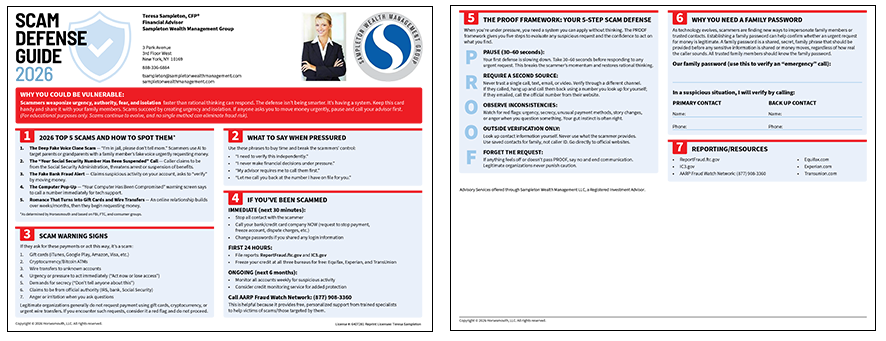
The presentation gives your clients knowledge. The Scam Defense Guide gives them something to take home and use.
The Scam Defense Guide is a fully branded, client-ready reference card that walks clients through the P.R.O.O.F. Framework step by step — the same system they just learned from you. It covers the top scams to watch for, the exact phrases to say when pressured, and a clear action plan for the first 30 minutes, 24 hours, and months after a scam occurs.
Clients keep it. They put it on the refrigerator. They hand it to a parent or a spouse.
Every advisor who presents Scams, Frauds, and Deep Fakes gets the Scam Defense Guide included — personalized with your name, photo, firm, and contact information, ready to print and distribute in unlimited quantities.
Advisors who want it without the full Savvy Cybersecurity program can order it separately as a standalone, custom (PDF) or custom printed with 100+ printed copies. But for Savvy Cybersecurity members, it's already yours.
What the Savvy Cybersecurity Program Includes 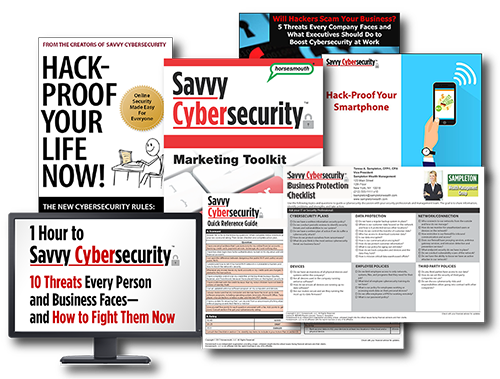
Annual License
Present any Savvy Cybersecurity content to clients and prospects as often as you like for one full year — workshops, seminars, client meetings, and community events.
5 Educational Presentations
NEW — Scams, Frauds, and Deep Fakes: Smart Rules Every Family Needs to Know Now 
The new flagship. 71 slides with speaker notes. Covers romance scams, investment fraud, government impersonation, deepfakes, the P.R.O.O.F. Framework, and the 24-hour recovery plan. FINRA-reviewed pending.
1 Hour to Savvy Cybersecurity: 10 Threats Every Person and Business Faces — and How to Fight Them Now 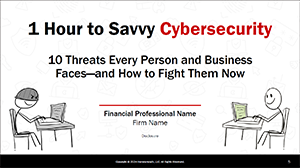
The foundational workshop that has educated clients across the country. Teaches three cybersecurity mindsets and the rules that keep clients as safe as possible. Attendees complete their own cybersecurity scorecard and build a personal action plan. FINRA-reviewed.
30 Minutes to Savvy Cybersecurity: 5 Threats Every Person and Business Faces
A shorter version of the 1-Hour workshop. Perfect for lunch meetings or limited time slots. 20+ slides. 
Will Hackers Scam Your Business? 5 Threats Every Company Faces
A one-hour presentation for your business owner and executive clients and prospects. 45+ slides and speaker notes. Introduces the top cybersecurity threats facing businesses and the actions executives should take to safeguard company data. 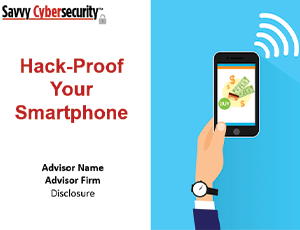
Hack-Proof Your Smartphone
Eight critical steps to protect the device that has become the digital nerve center of your clients' lives. Can be presented on its own or added to the 1-Hour workshop.
Client Resources

Savvy Cybersecurity Quick Reference Guide (PDF)
The interactive scorecard clients complete during the workshop. They measure their cybersecurity score, identify priority actions, and commit to a 3-step personal improvement plan — in writing, with a completion date. Research shows people who write down a goal and sign a commitment are significantly more likely to follow through.
Click Here For A Branded Sample
Savvy Cybersecurity Business Protection Checklist (PDF)
A two-sided, customizable checklist for business owner and executive clients. 40+ questions across eight cybersecurity topics designed to guide conversations with their IT team and CFO.
NEW: Scam Defense Guide (PDF)
The client-facing companion to the new Scams, Frauds, and Deep Fakes presentation. Clients take this home. It walks them through the P.R.O.O.F. Framework step by step and guides a family conversation about scam prevention. This is the resource they keep, refer back to, and share with family members.
Newsletters and Alerts
Savvy Cybersecurity Watch E-Newsletter (monthly)
The latest on new scams and frauds, what to do about them, and links to resources you can share immediately with clients. Includes updates on critical software vulnerabilities across Microsoft, Apple, Adobe, and other major platforms.
FINRA-Reviewed Article Reprints
Seven article reprints throughout the year that you can personalize and use in your client newsletter, on your website, or on LinkedIn. Recent titles include:
-
4 Common Elder Scams: How to Stay Safe and Fight Back
-
5 Ways to Boost Your Security Against ID and Credit Card Theft
-
Child ID Theft: 8 Steps to Keep Your Kids Safe
-
How to Create Ultra-Secure Passwords That Keep Hackers Away
-
Why a Credit Freeze Is the Best Response to a Data Breach
-
How to Know if You've Been Hacked
-
10 Ways to Protect a Small Business From Hackers
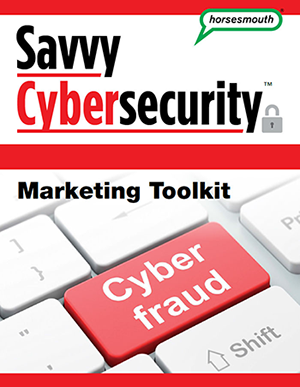
Marketing Toolkit
Fully customizable event toolkit — invitation flyer, press release, planning timelines, and templates — so you can run a professional workshop, fill the room, and make the event reflect your brand. Includes step-by-step planning guidance from announcement to follow-up.
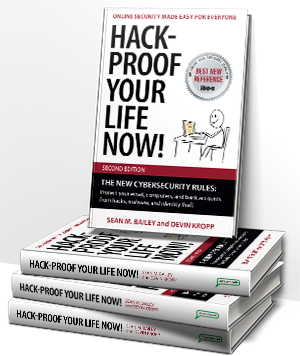
Bonus: Hack-Proof Your Life Now! — 10 Copies Included!
The award-winning, second-edition guide to the new cybersecurity rules. Ten copies delivered to your office. Give them to clients, use them as conversation starters, or hand them to the business owners you want to bring in as new clients.
7 Reasons Financial Advisors Are Joining Savvy Cybersecurity Now
Eighty-six percent of financial advisors surveyed have had at least one client targeted by fraud or scams in the past five years. This is no longer a topic to get around to. It is happening now, in practices like yours, and it is accelerating.
Here is why advisors who care about their clients and their practices are making this move:
-
Because your clients are already being targeted. Our survey of more than 400 financial advisors found that 86% have had at least one client targeted by fraud or scams in the past five years. This is not a future risk. It is the present reality of financial advice.
-
Because deepfakes have permanently changed what "suspicious" looks like. A call can sound exactly like a grandchild. A video conference can show a CFO who does not exist. A voice on the phone can be indistinguishable from a bank representative. Your clients' instincts are no longer reliable defenses — but a system is.
-
Because nearly 3 in 4 advisors have suspected cognitive impairment made a client more vulnerable. As your clients age, their vulnerability to manipulation increases — and scammers know which populations to target. You need to be ahead of this before the call comes.
-
Because the advisor who prepares clients before the pressure moment is the one they remember for life. You cannot reach a client in the moment a scammer has them on the phone and is telling them not to hang up. But you can reach them now — and give them the tools, the framework, and the instinct to pause. That preparation is one of the most protective things you can do for them.
-
Because most of your peers still are not doing this. Only 37% of advisors surveyed feel very confident in their ability to identify financial fraud affecting their clients. That gap is an opportunity. Whoever fills it in your market becomes the advisor known for caring about more than portfolios.
-
Because the threat is accelerating. $16.6 billion lost in 2024. Up 33% from the year before. AI is making scams faster, more personal, more convincing, and harder to detect. Every year you wait is a year more of your clients are exposed without preparation.
-
Because your clients need a reason to call you before they act. The advisors in our survey who stopped frauds in progress share one thing: their clients called them first. Savvy Cybersecurity gives clients a reason to make that call — and gives you the knowledge to help them when they do.
What Advisors in Our Survey Did to Protect Their Clients
The Client Still Thanks Me to This Day
"A client called to take out retirement funds to put in a gold 'investment.' I knew it was a scam. I Googled everything and showed the client a satellite image of the supposed headquarters — a mailbox store next to a bail bonds office in Nevada. The client still thanks me to this day."
Thought His Grandson Needed Bail
"A client was going to send $10,000 cash via FedEx because he thought his grandson needed bail money. We stopped it before he sent it by having him call his grandson directly — who confirmed he did NOT need bail money."
She Called for Another $25,000
"After a client lost $50,000 to a romance scam, she called for another $25,000. I finally got her to open up. She told me she had been contacted by an 'international lawyer' who said he could recover her money for $25,000. I was able to stop that."
I’ll Let You Talk to Him
"A client was going to withdraw funds to bail out a nephew who stressed she should not call his father. I suggested she call the nephew's father and say, 'Your son crossed my mind this morning — I wondered how he's doing.' The father said: 'He's in the other room. I'll let you talk to him.'"
Stopped the Check at the Bank
"I stopped a $75,000 check with the client at the bank that she had sent to a romance scammer."
Every Red Flag in the World
"Client made an unexpected $100,000 withdrawal request and told me he 'couldn't talk about it, but don't worry — there's a lawyer involved.' I pressed him. It had every red flag in the world. I told him if he didn't believe me, to call the Georgia Bureau of Investigation and ask for elder care fraud. He did. They confirmed it was fraud."
These are real advisors. Real clients. Real money saved. In every case, the advisor was positioned to help because they had made fraud prevention part of how they serve clients — and because their clients trusted them enough to call before acting.
Risk-Free Guarantee
Professionals who educate their clients on financial fraud and cybersecurity differentiate themselves from other advisors and connect with clients at a deeper level. Our survey confirmed that advisors want to protect their clients from fraud and scams but often feel they lack the right resources to do so effectively. That is exactly what Savvy Cybersecurity provides.
Use Savvy Cybersecurity as your program for educating clients on scams, deepfakes, financial fraud, and cybersecurity. Take a full year to implement it. If after 12 months you do not feel more confident and more equipped to protect your clients — and more valued by them as a result — we will refund 100% of your purchase price. Guaranteed, no questions asked.
Call us at Horsesmouth, 230 Park Avenue, 3rd Floor West, New York, NY 10169. Phone: (212) 343-8760, Ext. 1.
Join Savvy Cybersecurity Today
The scammer who is targeting your client right now is not waiting for you to get ready.
But you have time to prepare your clients before the call comes.
Savvy Cybersecurity gives you everything you need to do that — presentations, client tools, monthly fraud intelligence, and a community of advisors who are serious about protecting the people who trust them.
When that client calls you instead of wiring the money, when they pause and verify instead of acting under pressure, when they tell their friends that their financial advisor is the one who protected them — that is the moment Savvy Cybersecurity pays for itself.
Join Savvy Cybersecurity Today
Request a Desktop Demo for Savvy Cybersecurity:
Demo includes:
-
Five Interactive Seminar Presentations
-
Scam Defense Guide
-
Savvy Cybersecurity Quick Reference Guide
-
Savvy Cybersecurity Business Protection Checklist
-
Savvy Cybersecurity Watch E-Newsletter (monthly)
-
Emergency Alert E-Newsletter
-
Article Reprints
-
Marketing Toolkit
Click here to sign up or call (888) 336-6884 ext. 1
About Horsesmouth
Since 1997, Horsesmouth has been helping financial professionals succeed by providing timely guidance on business development, practice management, financial planning, and investment strategies.
FOR INSTANT SERVICE: Call Toll Free 1-888-336-6884 ext. 1 | Outside U.S.: 1-212-343-8760